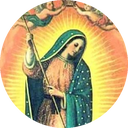
She Was with Child
The woman clothed with the sun is in labor. Her pain is real, but it is the pain of a birth God has already promised, and it ends in joy.
Home › Hope › Revelation 12 › 12:2
✓ Reviewed by Fr. John How this site is made
“She was with child and wailed aloud in pain as she labored to give birth.”Revelation 12:2
Revelation 12 is not a riddle about the future. It is a picture of God's whole plan of salvation, the plan he first announced in the garden. After the fall, God said to the serpent: “I will put enmity between you and the woman, and between your offspring and hers” (Genesis 3:15). In chapter 12 we finally see that woman, her child and the serpent, now grown into a dragon.
The New Eve labors in pain
To Eve God said, “in pain you shall bring forth children” (Genesis 3:16). The NABRE note on 12:2 points straight back to that verse: because of Eve's sin, the woman of Revelation gives birth in distress and pain. The same note sends us to Isaiah 66.
The woman stands first for God's people, Israel and then the Church. The Church has also always seen in her Mary, the Mother of Christ. Pope St. John Paul II said that in “the woman with child” Christian tradition “has seen an image of Mary, the Mother of Christ” (General Audience, 14 March 2001). She is the New Eve. Where the first Eve brought forth children into a fallen world, Mary brings forth the One who saves it.
Here we have to read carefully. The Church's common teaching is that Mary gave birth to Jesus in Bethlehem without the pains of childbirth. St. John Damascene says that birth was “painless.” Then he adds that she “suffered those pains, which she escaped at the birth, in the hour of the passion” (Exposition of the Orthodox Faith IV.14). So the labor of Revelation 12:2 is above all the labor of Calvary. There, beside the cross, Jesus said to her, “Woman, behold, your son,” and to the beloved disciple, “Behold, your mother” (John 19:26–27). In that hour of sorrow Mary was giving birth to us. As the Catechism says, “she is a mother to us in the order of grace” (CCC 968).
Born before her pangs
Isaiah saw something wonderful: “Before she is in labor, she gives birth; before her pangs come upon her, she delivers a male child” (Isaiah 66:7). “Yet Zion was scarcely in labor when she bore her children” (Isaiah 66:8). And the Lord asks, “Shall I bring a mother to the point of birth, and yet not let her child be born?” (Isaiah 66:9).
I find great hope in this. In God's eyes, Mary's labor is already accomplished. Christ is born, crucified and risen, and the victory is won. Yet the Church on earth still shares in the pains, and so do we. Jesus told his disciples so on the night before he died: “When a woman is in labor, she is in anguish because her hour has arrived; but when she has given birth to a child, she no longer remembers the pain because of her joy” (John 16:21). Our sorrow is real, but it is the sorrow of a birth, and he promises that “no one will take your joy away from you” (John 16:22).
Only the Lord can build the house
King David once looked at his palace and said, “Here I am living in a house of cedar, but the ark of God dwells in a tent!” (2 Samuel 7:2). God answered that David would not build him a house. Instead, “the LORD will make a house for you” (2 Samuel 7:11). David's son Solomon built the temple, and it was glorious. But it was made of stone, and it was destroyed.
Only our Lord can build a true and eternal dwelling place. “Unless the LORD build the house, they labor in vain who build” (Psalm 127:1). He began that work in Mary herself, preserving her from all stain of sin from the first moment of her conception (CCC 491), so that she could be a worthy home for his Son. Then “the Word became flesh and made his dwelling among us” (John 1:14).
St. Paul puts it simply: “when the fullness of time had come, God sent his Son, born of a woman, born under the law, to ransom those under the law, so that we might receive adoption” (Galatians 4:4–5). The child Mary bears is not only her Son. Through him we become God's children too, and the Spirit in our hearts cries out, “Abba, Father!” (Galatians 4:6).
The cornerstone of the new and eternal Temple
By becoming flesh, Christ forms a Body: the Body of Christ, with Jesus Christ as the head and all God's children as its members. “He is the head of the body, the church” (Colossians 1:18). That Body is the new and eternal Temple.
St. Augustine, preaching on Psalm 127 (126 in his numbering), says that the true builder is not Solomon but Christ, the true peacemaker: “the Lord Jesus Christ builds His own house.” And what is that house? “The house of God is the people of God” (Expositions on the Psalms, 127, 1–2). St. Paul shows how Christ builds it. He “made both one,” Jew and Gentile, and “broke down the dividing wall of enmity” (Ephesians 2:14). On the foundation of the apostles and prophets, with Christ Jesus himself as the capstone (the stone that holds the whole building together), “the whole structure is held together and grows into a temple sacred in the Lord” (Ephesians 2:20–21). Christ is the cornerstone of the new and eternal Temple, and we are being built into it.
Groaning in hope
This building is not yet finished, and that is why the woman still cries out. St. Paul hears the same cry in all of creation: “We know that all creation is groaning in labor pains even until now; and not only that, but we ourselves, who have the firstfruits of the Spirit, we also groan within ourselves as we wait for adoption, the redemption of our bodies” (Romans 8:22–23).
So when you suffer, do not think God has forgotten you. You are part of the labor of the woman clothed with the sun. Mary is with you as a mother, and the One she bore has already won. The pain is real, but it is the pain of a birth, and joy is coming.
Sources
- Scripture: New American Bible, Revised Edition, at bible.usccb.org, including the NABRE note on Revelation 12:2.
- Catechism of the Catholic Church, 491 and 963–970 (vatican.va).
- Pope St. John Paul II, General Audience, 14 March 2001 (“Mary, eschatological icon of the Church”).
- St. John Damascene, Exposition of the Orthodox Faith IV.14 (newadvent.org).
- St. Augustine, Expositions on the Psalms, Psalm 127 (newadvent.org).