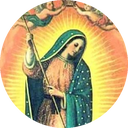
A Woman Clothed with the Sun
Before we hear one word about the dragon, we see what God's love has done. That is the right order for thinking about spiritual warfare: love first, and hope before fear.
Home › Hope › Revelation 12 › 12:1
✓ Reviewed by Fr. John How this site is made
“A great sign appeared in the sky, a woman clothed with the sun, with the moon under her feet, and on her head a crown of twelve stars.”Revelation 12:1
Revelation 12 is about a struggle that runs through all of history. A huge red dragon is coming, waiting to devour a child. But St. John doesn't open with the dragon. He opens with a woman, bright with the light of God. Before we hear one word about the enemy, we see what God's love has done. That is the right order for thinking about spiritual warfare: love first, and hope before fear.
So who is this woman?
Mary, and the people of God
Is she Mary? The New Eve? Israel? The Church? The Queen of Heaven? The Church's answer is generous: we do not have to pick just one.
The note on this passage in the New American Bible says the woman “symbolizes God's people in the Old and the New Testament.” Israel gave birth to the Messiah, and then, as the new Israel, the Church, she is persecuted by the dragon. Pope Benedict XVI put both readings in one sentence: “This Woman represents Mary, the Mother of the Redeemer, but at the same time she also represents the whole Church, the People of God of all times, the Church which in all ages, with great suffering, brings forth Christ ever anew.”
The Catechism reads the chapter with Mary in mind. The dragon “pursued the woman” but had no hold on her: “the new Eve, ‘full of grace’ of the Holy Spirit, is preserved from sin and the corruption of death” (CCC 2853). Pope Francis adds that Mary also accompanies “the rest of her offspring, those who keep the commandments of God and bear testimony to Jesus” (Revelation 12:17; Evangelii Gaudium 285). That means us.
These are not rival answers. Mary is the first and finest member of God's people, and what God did fully in her he wants to do in all of us.
Four witnesses
Blessed Isaac of Stella, a Cistercian abbot whose sermon the Church reads in the Office of Readings during Advent, wrote: “In the inspired Scriptures, what is said in a universal sense of the virgin mother, the Church, is understood in an individual sense of the Virgin Mary.” He then goes a step further: “In a way, every Christian is also believed to be a bride of God's word, a mother of Christ.” The woman is Mary, she is the Church, and in a quieter way she is each faithful soul.
St. Irenaeus of Lyons saw Mary as the New Eve. “The knot of Eve's disobedience was loosed by the obedience of Mary,” he wrote. “For what the virgin Eve had bound fast through unbelief, this did the virgin Mary set free through faith” (Against Heresies III.22.4). Elsewhere he calls Mary the “advocate” of Eve (V.19.1). The woman of Revelation 12 shows the outcome of that obedience: a mother whom the serpent cannot overcome.
St. Lawrence of Brindisi, the Capuchin Doctor of the Church, preached a whole series of sermons on this vision. In one of them he reminds us where the woman's splendor comes from: “It was from the Child in her womb that Mary received all her glory. He clothed her with the sun, rolled the moon beneath her feet, and set upon her head a crown of twelve stars.” Her glory is her Son's gift. The light is his, and he loves to share it.
St. Bonaventure, writing on the joy of heaven in his Soliloquy, reads the woman clothed with the sun as a picture of the soul in glory. “This woman, I think, is the blessed soul, daughter, bride and queen of the eternal King: daughter by creation, bride by the adoption of grace, queen by the gift of glory.” He takes the twelve stars as the twelve joys that adorn the happiness of heaven. He borrows an image from St. Jerome's letter to Eustochium, of the day when Mary, “the mother of the Lord, shall come to meet you, accompanied by her virgin choirs.” Then he urges the soul on in his own words: “Run, then, O soul, not with the steps of the body but with longing and desire,” because the Father waits for you as a dearly loved daughter, the Son as his bride, and the Holy Spirit as a cherished friend.
Armor for the struggle
The fight is real, and St. Paul says so: “For our struggle is not with flesh and blood but with the principalities, with the powers, with the world rulers of this present darkness, with the evil spirits in the heavens” (Ephesians 6:12).
But notice where our strength comes from: “Finally, draw your strength from the Lord and from his mighty power. Put on the armor of God so that you may be able to stand firm against the tactics of the devil” (Ephesians 6:10–11). The armor belongs to God, and he gives it to us: truth, righteousness, readiness for “the gospel of peace,” faith as a shield “to quench all [the] flaming arrows of the evil one,” and “the helmet of salvation and the sword of the Spirit, which is the word of God” (Ephesians 6:15–17). We put it on in prayer, the sacraments, and Scripture.
Pope Benedict noted that while the woman is threatened by the dragon, “she is also protected by God's comfort. And in the end this Woman wins.” God cares for her in the desert. The child is caught up to God. The dragon is furious because he has already lost.
So let us keep our hearts set on the joys of heaven, as St. Bonaventure teaches. That is not an escape from the fight. When our thoughts rest on what God has prepared for those who love him, this exile becomes the vestibule of the heavenly kingdom. Even in our spiritual warfare, we walk toward home, and the Woman clothed with the sun walks with us.
Sources
- Revelation 12 (NABRE), with notes; Ephesians 6 (NABRE)
- Pope Benedict XVI, General Audience, August 23, 2006
- Catechism of the Catholic Church 2853
- Pope Francis, Evangelii Gaudium 285, quoting Isaac of Stella, Sermon 51 (PL 194, 1863, 1865), and citing Revelation 12:17
- Bl. Isaac of Stella, Sermon 51, Office of Readings, Saturday of the Second Week of Advent
- St. Irenaeus, Against Heresies III.22.4; V.19.1
- St. Lawrence of Brindisi, Mariale, Sermon Six on the Vision of St. John, trans. Vernon Wagner, O.F.M. Cap. (1952), as quoted in Stanley Gahan, “‘The Woman Clothed with the Sun’ According to St. Lawrence of Brindisi” (1962)
- St. Bonaventure, Soliloquium (Latin text), on heavenly joy; English by Claude for this site
- St. Jerome, Letter 22 to Eustochium, section 41