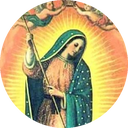
The Woman in the Desert
The dragon is waiting, but the woman is not left alone. God has prepared a place for her, and there she is cared for.
Home › Hope › Revelation 12 › 12:6
✓ Reviewed by Fr. John How this site is made
“The woman herself fled into the desert where she had a place prepared by God, that there she might be taken care of for twelve hundred and sixty days.”Revelation 12:6
The child has been caught up to God. The dragon is still there. And the woman runs, not into danger, but into “a place prepared by God.” I love that phrase. Before we hear how long she must stay, we hear who got the place ready. The verse is not mainly about flight. It is about care.
The woman is a profound symbol. She is the Blessed Virgin Mary. She is God's people, Israel and the Church. And she is the hope of salvation, held out to every one of us. On this verse all three meet.
Mary after the Ascension
We know very little about Mary's life after her Son returned to the Father. St. Luke shows her in the upper room with the apostles: “All these devoted themselves with one accord to prayer, together with some women, and Mary the mother of Jesus, and his brothers” (Acts 1:14). From the cross Jesus had given her to the beloved disciple, and from that hour John took her into his home (John 19:26–27).
St. Amadeus of Lausanne, a twelfth-century Cistercian bishop, meditated on those years. The Church reads part of his seventh homily on the Virgin Mary in the Office of Readings on August 22, the memorial of the Queenship of Mary. He pictures John, with the other apostles, caring for the Mother entrusted to him at the cross. He describes her turning to God in prayer, and then turning back to her neighbors with a love beyond words. And he says something beautiful: “she began to taste the fruits of her future reign while still in the flesh.” Angels served her in heaven, he writes, while on earth she was honored by the service of men.
That is the first meaning of the desert I want to hold on to. Mary stayed on earth for a time, in a place God had prepared, praying for the young Church. The world was hostile. She was not afraid. She was already living close to heaven.
Assumed and crowned
Her time in the desert came to an end. In 1950 Pope Pius XII defined that “the Immaculate Mother of God, the ever Virgin Mary, having completed the course of her earthly life, was assumed body and soul into heavenly glory” (Munificentissimus Deus 44). The Catechism calls the Assumption “a singular participation in her Son's Resurrection,” and a foretaste of the resurrection God promises to all Christians (CCC 966).
Four years later, in Ad Caeli Reginam, the same Pope taught the Queenship of Mary. He wrote that she “reigns with a mother's solicitude over the entire world.” Notice the words. Her reign is not distant. It is a mother's reign, and a mother's reign is care.
So the woman who once was cared for in the desert now cares for those still in it. The Catechism says that Mary, glorified in heaven, shines on earth “until the day of the Lord shall come, a sign of certain hope and comfort to the pilgrim People of God” (CCC 972, quoting Lumen Gentium 68).
Our desert, too
Mary is “Mother of Christ, Mother of the Church” (CCC 963). A mother is one with her children. What happened to her is a promise of what God wants to do for all of them. That is why the woman of this verse is also the Church, and each of us.
The NABRE note on 12:6 says that God protects the persecuted Church in the desert, “the traditional Old Testament place of refuge for the afflicted.” Think of the Exodus. Israel fled Egypt into the wilderness, and God said, “I bore you up on eagles' wings and brought you to myself” (Exodus 19:4). Revelation uses the same image a few verses later, when the woman is given “the two wings of the great eagle” (Revelation 12:14). Think of Elijah, worn out and wanting to die under a broom tree. An angel woke him and fed him: “Get up and eat or the journey will be too much for you!” (1 Kings 19:4–8). Think of Hosea, where God says of his people, “I will lead her into the wilderness and speak persuasively to her” (Hosea 2:16). In Scripture the desert is hard, but it is also where God feeds, carries and speaks tenderly.
And the twelve hundred and sixty days? The NABRE note on 11:2 explains that three and a half years, half of seven, recalls the persecution under Antiochus and became the pattern for periods of trial for God's people. The common reading in the Church is that this is a limited time. It is real, it is hard, and it is under God's care. It does not last forever. For all believers it is a time of tribulation and purification. I have also asked whether the number might be meant literally, alongside the forty-two months of Revelation 13:5–7. That reading is set out, as a test only and with no date, on The Timing.
Cared for on the way
The verb in this verse is passive: she is “taken care of.” The woman does not feed herself in the desert. God does. The Father who prepared the place, the Son who went ahead of us to prepare a place (John 14:2), and the Holy Spirit who sustains the Church: the Trinity takes care of us. And Mary, our Mother, takes care of us with them.
The Church is on pilgrimage through this desert toward heaven. Some days the road is dry and long. But the place is prepared. The bread comes, as it came to Elijah. In the Eucharist it comes every day. And the Mother who walked this road before us, and who already tasted the fruits of her reign while still on earth, is waiting at its end, and walking beside us on the way.
Sources
- Revelation 12 (NABRE), with notes (note on 12:6); Revelation 11 (NABRE) (note on 11:2)
- NABRE: Acts 1; Exodus 19; 1 Kings 19; Hosea 2
- Catechism of the Catholic Church 963–975, especially 963, 966 and 972 (quoting Lumen Gentium 68)
- Pope Pius XII, Munificentissimus Deus (1950), 44
- Pope Pius XII, Ad Caeli Reginam (1954)
- St. Amadeus of Lausanne, Homily 7 on the Virgin Mary (SC 72), “Queen of the world and of peace,” Office of Readings, August 22, Queenship of the Blessed Virgin Mary